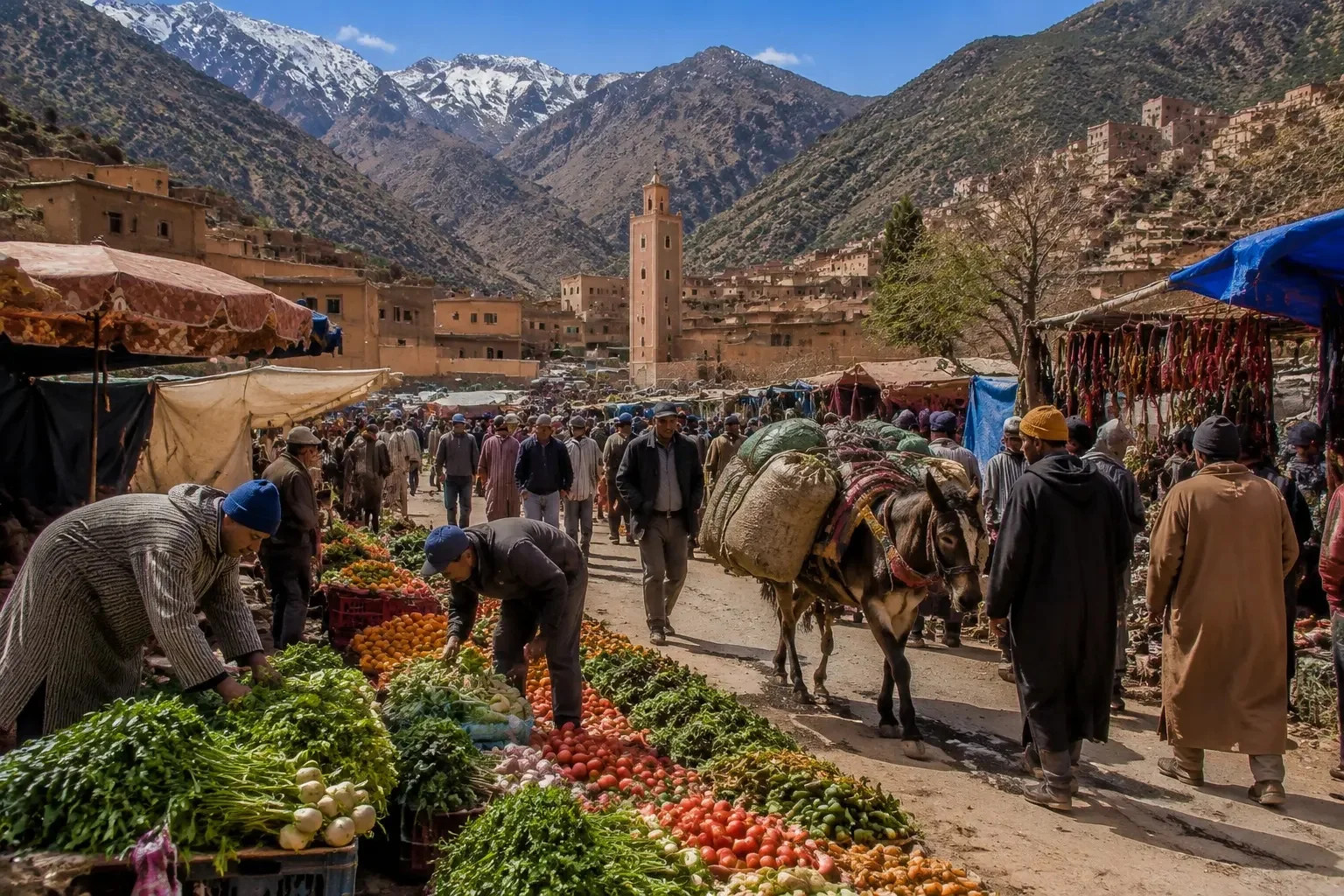
Berber culture, increasingly called Amazigh culture, is the culture of North Africa’s original inhabitants, and it is still very much alive in the High Atlas villages around Ouirgane. You discover it in everyday life rather than in a museum: a language, Tachelhit; a hospitality that always begins with mint tea; and village life shaped by the seasons, weekly souks and communal celebrations. Here is our guide, as local hosts, to understanding and respecting it.
Key facts
- People: the Imazighen (singular Amazigh), a name often translated as “free people”
- Language around Ouirgane: Tachelhit; Amazigh has been an official language of Morocco since 2011
- Script: Tifinagh, visible on many public signs and buildings
- Main festival: Yennayer, the Amazigh New Year, in mid-January, a public holiday in Morocco since 2024
- Nearest market: Asni souk, every Saturday, about 15 km from Ouirgane
Who are the Berbers of the High Atlas?
The Berbers, or Imazighen, have lived in North Africa since antiquity, long before the arrival of Islam and the Arabic language. In Morocco a large share of the population has Amazigh roots, and millions of people still speak a Berber language every day. In the western High Atlas, between Asni, the N’Fis valley and the Toubkal massif, the villages are home to farming and herding families who have lived there for generations. For the historical background, the Berbers article on Wikipedia is a good starting point.
What language do people speak around Ouirgane?
Around Ouirgane, most people’s mother tongue is Tachelhit (also called Shilha), the Amazigh language of the western High Atlas, the Anti-Atlas and the Souss. The Middle Atlas mainly speaks Central Atlas Tamazight, and the Rif speaks Tarifit. Almost everyone also understands Darija, Moroccan Arabic, and many younger people learnt French at school.
Since the 2011 Constitution, Amazigh has been an official language alongside Arabic, and the Royal Institute of Amazigh Culture (IRCAM) has standardised the Tifinagh alphabet you will spot on schools and public buildings. Two words go a long way: azul (hello) and tanmirt (thank you). Our list of useful Moroccan Arabic and Tachelhit phrases will give you plenty more.
What is Berber hospitality like?
In the High Atlas, a visitor rarely leaves without being offered something. Mint tea appears quickly, with bread baked in a clay oven, olive oil and sometimes honey or amlou. Politely declining once is acceptable, but accepting always gives pleasure. People eat with the right hand, take their time to sit down and never rush away from the table.
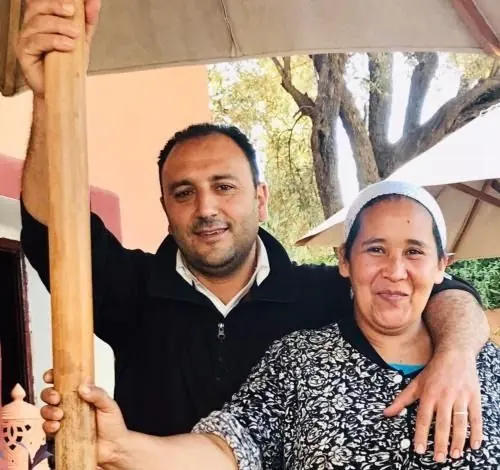
We try to share this hospitality at the auberge: the homemade breakfast and Rachida’s dishes, served in our family-style Moroccan restaurant, follow the recipes of the region. It is not a show; it is simply how we welcome people.
What is daily life like in a Berber village?

Villages cling to the hillsides, with houses of rammed earth or stone, cultivated terraces and irrigation channels, the seguias, which share water between families according to age-old rules. Depending on altitude, people grow barley, maize, vegetables, walnuts, olives or apples, and most households keep a few goats or sheep. The mosque, the bread oven and the school shape community life, and the village assembly, the jmaa, still settles many shared questions.
Life follows the seasons: barley is harvested in early summer, walnuts at the end of summer and olives in late autumn. The best way to discover these hamlets without intruding is to walk with a guide from the valley, as we explain in our article on Berber villages near Marrakech.
Which festivals and traditions shape Berber culture?
Berber culture is above all communal. Yennayer, the Amazigh New Year, is celebrated in mid-January with a family meal, often couscous or a grain-based dish, and 14 January has been an official public holiday in Morocco since 2024. Weddings and moussems, seasonal festivals linked to a local saint or to the harvest, bring out the ahwach, the High Atlas tradition of collective song and dance in which rows of men and women answer each other to the beat of frame drums.
Moussem dates change every year and are rarely announced far in advance. If a celebration takes place during your stay, just ask us: we will tell you whether visitors are welcome and how to behave.
Which Berber crafts should you look out for?
Amazigh craftsmanship is practical first: wool rugs and blankets, pottery, basketry and silver jewellery such as fibulae and the khamsa (hand of Fatima). The geometric patterns, also found in old facial tattoos and henna designs, often carry meanings of protection or fertility, although interpretations vary from one family to another.
The most famous weaving comes from the Middle and High Atlas. To recognise a good piece and bargain with confidence, read our guide to Berber rugs and Atlas crafts. At Asni’s Saturday souk, crafts sit alongside everyday goods, which makes it a genuine valley market rather than a tourist bazaar.
How do you behave respectfully in a Berber village?
A few simple gestures make all the difference:
- Cover shoulders and knees, men and women alike, especially in villages.
- Always ask before photographing someone, and accept a refusal.
- Do not hand out sweets or money to children; support a local school or association instead.
- Greet people first, take your shoes off when entering a home and keep your voice calm.
- Avoid public displays of affection and alcohol in villages.
In return, you will often be invited for tea. Say yes: it is the warmest way into Berber culture.
Read next: Atlas Mountains Kasbahs: Earth Architecture and Where to See It
Where can you experience Berber culture during your stay?
Ouirgane, about 1 hour 15 minutes from Marrakech, makes an ideal base: the villages, Asni souk and the trails of Toubkal National Park are all close by. From the auberge we organise hikes with a local guide, a visit to Asni souk on Saturdays, a cooking class with Rachida and a traditional hammam; everything is described on our activities in the High Atlas page.
To stay in a small family-run auberge, in one of our four suites, book direct on our website or message us on WhatsApp: there is no middleman, and we answer all your questions ourselves.
Frequently asked questions
What is the difference between Berber and Amazigh?
Amazigh (plural Imazighen) is the name Berbers use for themselves, often translated as “free person”. “Berber” is an outside term that remains very common; in Morocco both are used, but “Amazigh” is preferred in official and cultural contexts.
Which Berber language is spoken near Marrakech?
In the western High Atlas, around Ouirgane, Asni and Imlil, people mainly speak Tachelhit, also known as Shilha. In Marrakech itself Darija dominates, but Tachelhit is widely heard and French is broadly understood in tourism.
Can you visit a Berber village without a guide?
Nothing stops you walking through a village on your own, but a local guide eases conversations, explains customs and keeps you from wandering into private spaces by mistake. It is also a way for villagers to benefit directly from your visit.
When is the Berber New Year?
Yennayer marks the start of the Amazigh agricultural year and is celebrated between 12 and 14 January depending on the region. In Morocco, 14 January has been an official public holiday since 2024, and families share a traditional meal that day.
Good tips from the High Atlas
One letter per season: hikes, Rachida’s recipes and early availability. No spam.


