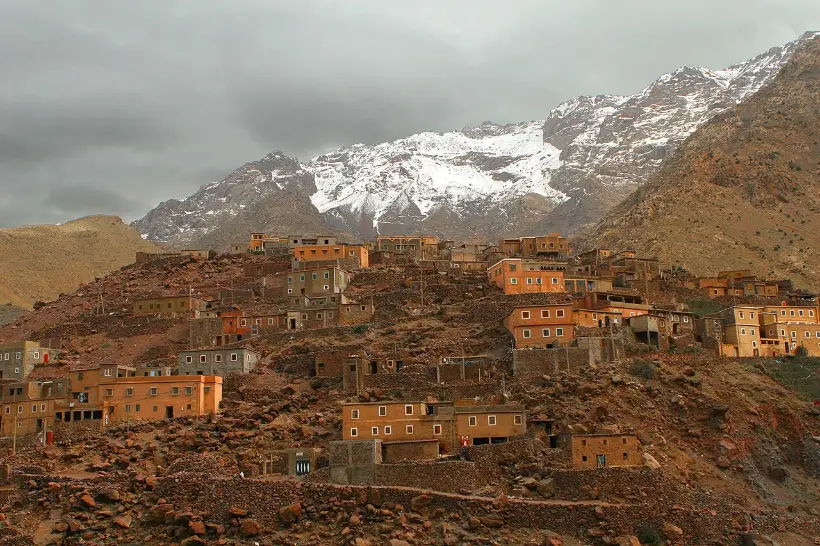

A dozen or so useful Moroccan Arabic phrases can transform a trip to Morocco: "salam alaykum" to say hello, "shukran" to say thank you, "bshhal?" to ask a price. Around Ouirgane, where people also speak Tashelhit, a simple "azul" or "tanmmirt" brings out smiles and opens many doors.
Key facts
- Darija: Moroccan Arabic, the everyday language across the country
- Tashelhit: the Amazigh (Berber) language of the Souss, the Anti-Atlas and the western High Atlas, spoken in the Ouirgane valley
- Status: Amazigh has been an official language since the 2011 Constitution, written in Tifinagh (ⴰⵣⵓⵍ = azul)
- French is widely understood in tourism, and English increasingly so
- Five words to remember: salam, shukran, afak, wakha, bslama
How do you pronounce Darija?
There is no official Latin spelling, so we use a simple English-friendly transcription. Remember four sounds:
- kh sounds like the "ch" in Scottish "loch" (khobz, bread);
- gh is close to a French rolled "r" (ghali, expensive);
- 3 marks the "ayn", a sound from the throat; if in doubt, just stress the vowel;
- q is a "k" pronounced deep in the throat.
The good news is that Darija borrows plenty of words from French and Spanish, such as tomobil (car), sbitar (hospital) or kuzina (kitchen), so you may recognise more than you expect. Do not worry about your accent: the effort is always appreciated. Many Darija words change for masculine and feminine, so we give both forms where useful.
Which useful Moroccan Arabic phrases help you say hello?
- Salam alaykum: hello ("peace be upon you"); reply: wa alaykum salam
- Sbah lkhir: good morning; reply: sbah nnur
- Msa lkhir: good evening
- Labas?: how are you?; reply: labas, lhamdulillah (fine, thank God)
- Kidayr? / Kidayra?: how are you doing? (to a man / to a woman)
- Smiti…: my name is…
- Mrehba bik: welcome
- Bslama: goodbye
Greetings take time in Morocco: people ask about your health and your family, and the answer is always "lhamdulillah". Women often greet each other with kisses on the cheek; between a man and a woman who do not know each other, it is best to wait for the other person to offer a hand.
How do you say thank you, please and no thank you?
- Shukran / shukran bzzaf: thank you / thank you very much
- Afak (or 3afak): please
- La, shukran: no thank you, the perfect phrase for persistent sellers
- Smeh liya: excuse me, sorry
- Wakha: OK; iyeh: yes; la: no
- Ma fhemtsh: I don't understand
- Inshallah: God willing, used for any future plan
How do you count and ask the price at the souk?
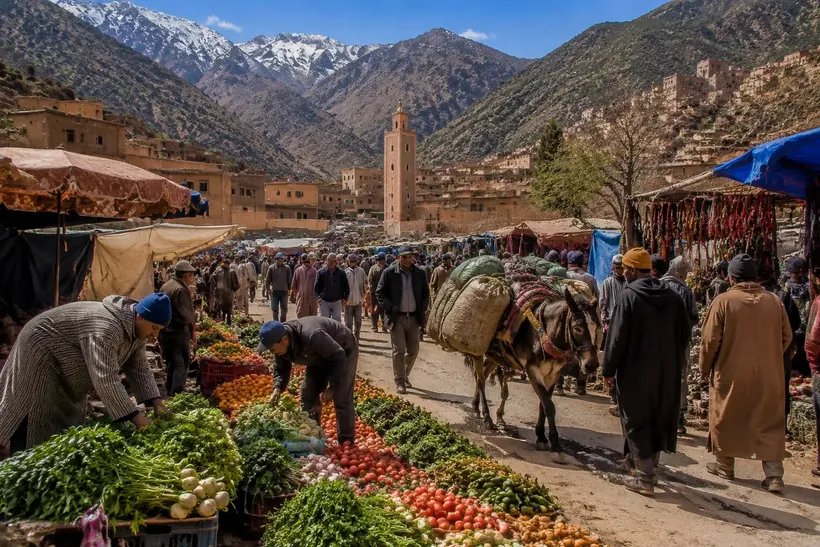
At the souk, a handful of words go a long way: bshhal hadi? (how much is this?), ghali bzzaf (too expensive), nqess shwiya (lower it a little) and safi (that's fine, that's enough).
Numbers from 1 to 10: wahed, jouj, tlata, rb3a, khamsa, stta, sb3a, tmnya, ts3ud, 3ashra. Add 3ishrin (20), khamsin (50) and mya (100).
Beware the ryal trap: in markets, people sometimes count in rials, with 20 rials to 1 dirham. So "mya ryal" means 5 dirhams, not 100. Asni's weekly Saturday souk is the best place to practise: read our guide to Asni and its Saturday Berber souk.
Which words are useful at the table?
- Bismillah: in the name of God, said before you start eating
- Bssaha: enjoy your meal, or "to your health" afterwards
- Bnin bzzaf: very tasty, delicious
- Atay b na3na3: mint tea; bla sukkar: without sugar; shwiya d sukkar: a little sugar
- Lma: water; khobz: bread
- Shb3t: I'm full
- Lhamdulillah: thank God, said at the end of the meal
There is no better way to use these words than cooking with Rachida: the cooking class is one of our activities at the auberge.
A few words of Tashelhit for Atlas villages
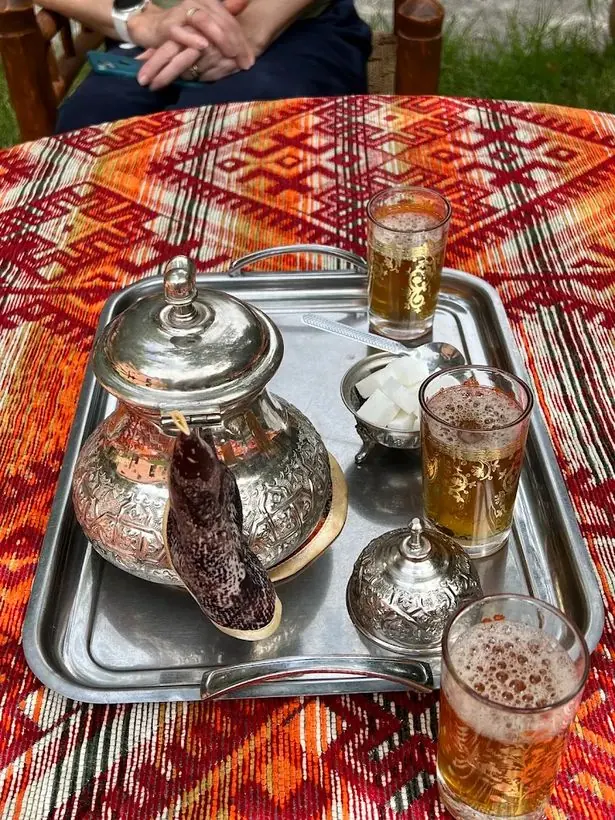
In the Ouirgane valley, the language spoken at home is often Tashelhit, one of the languages of the Berbers, or Amazigh people. A few words always go down well:
- Azul: hello (reply: azul)
- Manzakin?: how are you?; reply: labas, lhamdulillah
- Tanmmirt: thank you
- Yah / uhu: yes / no
- Aman: water; aghrum: bread; tamment: honey; atay: tea
- Yan, sin, krad, kkuz, smmus: one, two, three, four, five
For prices, people usually switch to Darija. To learn more about Amazigh traditions, read our article on Berber and Amazigh culture.
Politeness: the gestures that go with the words
Words are not everything. Place your right hand on your heart after a handshake, use your right hand to give and receive, and accept at least one glass of tea. Before taking a picture, ask mumkin nsawwrek? (may I take your photo?) and respect the answer. You will find more customs in our Morocco travel tips for the Atlas.
Practise your Darija during your stay
Conversation is still the best teacher. At Auberge Le Mouflon, feel free to try out your first words with Abdellah and Rachida, over breakfast or a tagine at the auberge restaurant. Book your stay in Ouirgane direct, with no middleman, or message us on WhatsApp: a simple "salam" is enough to get started.
Before you travel, save these useful Moroccan Arabic phrases on your phone: offline, at the souk or on a hike, they will come in handy. And if a word escapes you, a smile and a "shukran" will do the rest.
Frequently asked questions
How do you say thank you in Moroccan Arabic?
In Darija you say "shukran", or "shukran bzzaf" for thank you very much. In Amazigh villages of the Atlas you can also say "tanmmirt" in Tashelhit, which is always warmly received.
What does "azul" mean?
"Azul" is the Amazigh greeting, the equivalent of "hello", understood in Morocco's Berber-speaking regions. You simply reply "azul", and the word is written ⴰⵣⵓⵍ in the Tifinagh alphabet.
Is Darija different from Standard Arabic?
Yes, Darija is an Arabic dialect specific to Morocco, enriched with Amazigh, French and Spanish words. It is used in everyday life, while Modern Standard Arabic is used in writing, the media and administration.
Can you get by in Morocco with only English or French?
Yes, French is very widespread, especially in tourism, and English is increasingly spoken by young people and guides. Even so, a few words of Darija or Tashelhit remain the best way to make a genuine connection.
Good tips from the High Atlas
One letter per season: hikes, Rachida’s recipes and early availability. No spam.